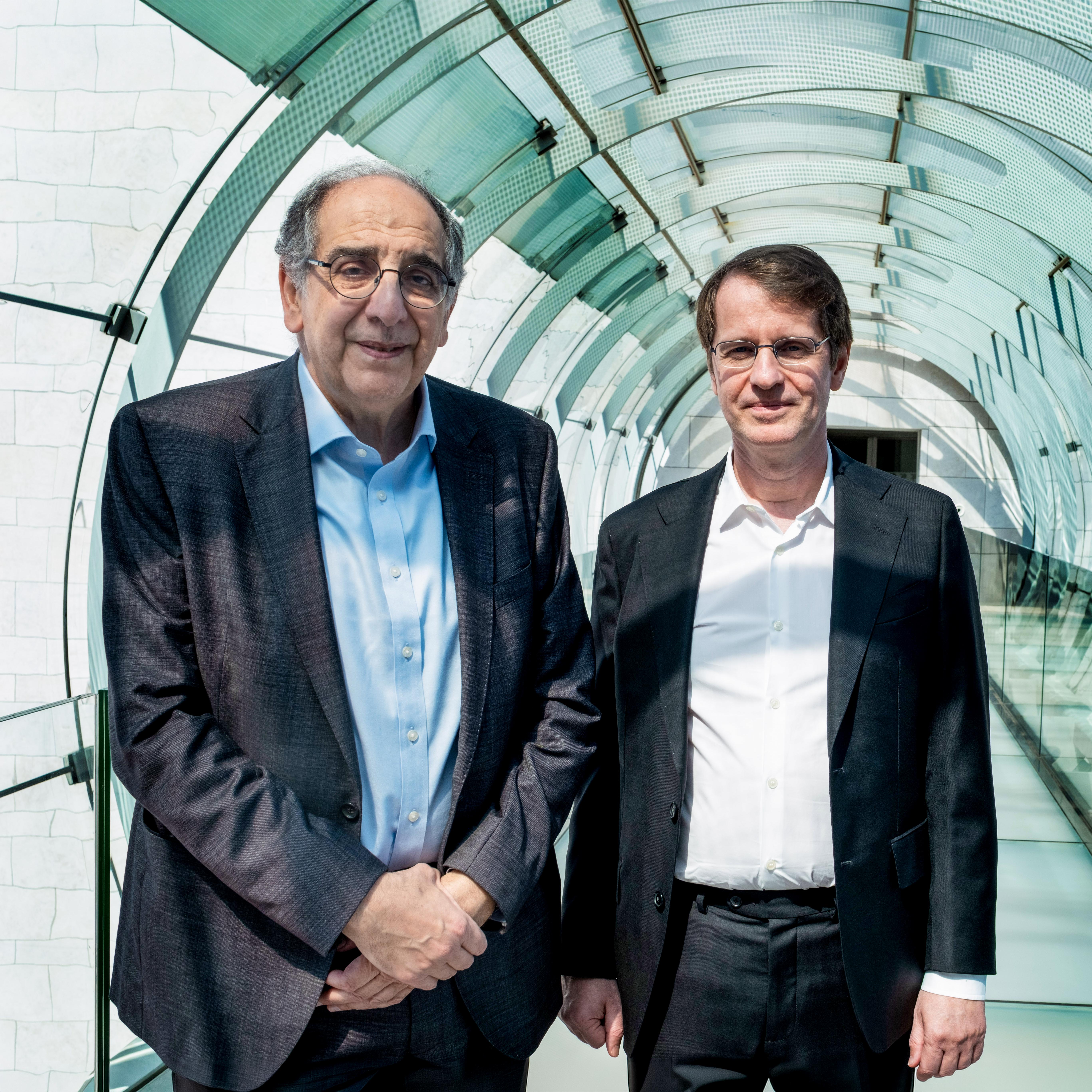
Professors Botond Roska and José-Alain Sahel are among the most creative and prolific researchers worldwide in the development of technologies aimed at restoring vision. Their work is a remarkable example of translational research, linking discoveries in fundamental biology to clinical practice to develop new therapies against vision loss.
Worldwide, 43 million people are blind and 295 million live with visual impairment, many of them as a result of retinal disease and macular degeneration.
The two researchers developed optogenetic therapies that make it possible to render light-sensitive some retinal cells that remain functional, even after the photoreceptor cells have already been destroyed by disease. In simple terms: these approaches help the retina respond to light again, opening up the possibility of partially restoring vision.
Despite scientific advances, treatments capable of restoring functional vision after loss caused by inherited retinal dystrophies or age-related macular degeneration remain scarce. Over more than two decades of work, both individually and in collaboration, Roska and Sahel have helped change this picture.
In animal models of inherited retinal degeneration, activating "dormant" retinal ganglion cells, bipolar cells or cone photoreceptors made it possible to restore some degree of visual function. These approaches were later tested in human clinical trials, demonstrating that partial recovery of vision in patients is possible.
Botond Roska, M.D., Ph.D., a Hungarian-Swiss physician and biomedical researcher at the University of Basel and founding director of the Institute of Molecular and Clinical Ophthalmology (IOB) in Basel, Switzerland, is a retinal neurobiologist who has identified new and complex neuronal connections essential to the organisation of vision in the human and animal retina.
Roska developed techniques for mapping retinal circuits using trans-synaptic viruses and used genetic methods to introduce light-sensitive ion channels into the retina's ON bipolar cells. In animal models, he demonstrated that this strategy could activate retinal ganglion cells even in the absence of normal light-sensitive photoreceptors. These contributions have opened up new avenues for understanding visual information processing and for developing innovative approaches to vision restoration.
José-Alain Sahel, M.D., a French ophthalmologist and researcher, Director of the UPMC Vision Institute, Distinguished Professor and Chair of the Department of Ophthalmology at the University of Pittsburgh, United States of America, founding director of the Institut de la Vision in Paris, France, and former director of the ophthalmology departments at the Hôpital National de la Vision – Quinze-Vingts and the Hôpital Fondation Adolphe de Rothschild, France, carried out pioneering studies on vision loss caused by Leber Hereditary Optic Neuropathy (LHON).
In clinical trials, he demonstrated that expression of the mitochondrial ND4 gene can prevent blindness in patients with LHON. This gene therapy for LHON is now available in several countries.
Sahel also identified a key retinal protein that promotes the survival of cone photoreceptors, which are responsible for daytime vision. He named this protein Rod-derived Cone Viability Factor (RdCVF) and demonstrated that it can preserve cones regardless of the genetic cause of degeneration. These approaches, based on neurotrophic factors (factors that promote the survival of neuronal cells), have potential to treat a wide range of inherited and age-related diseases affecting the retina.