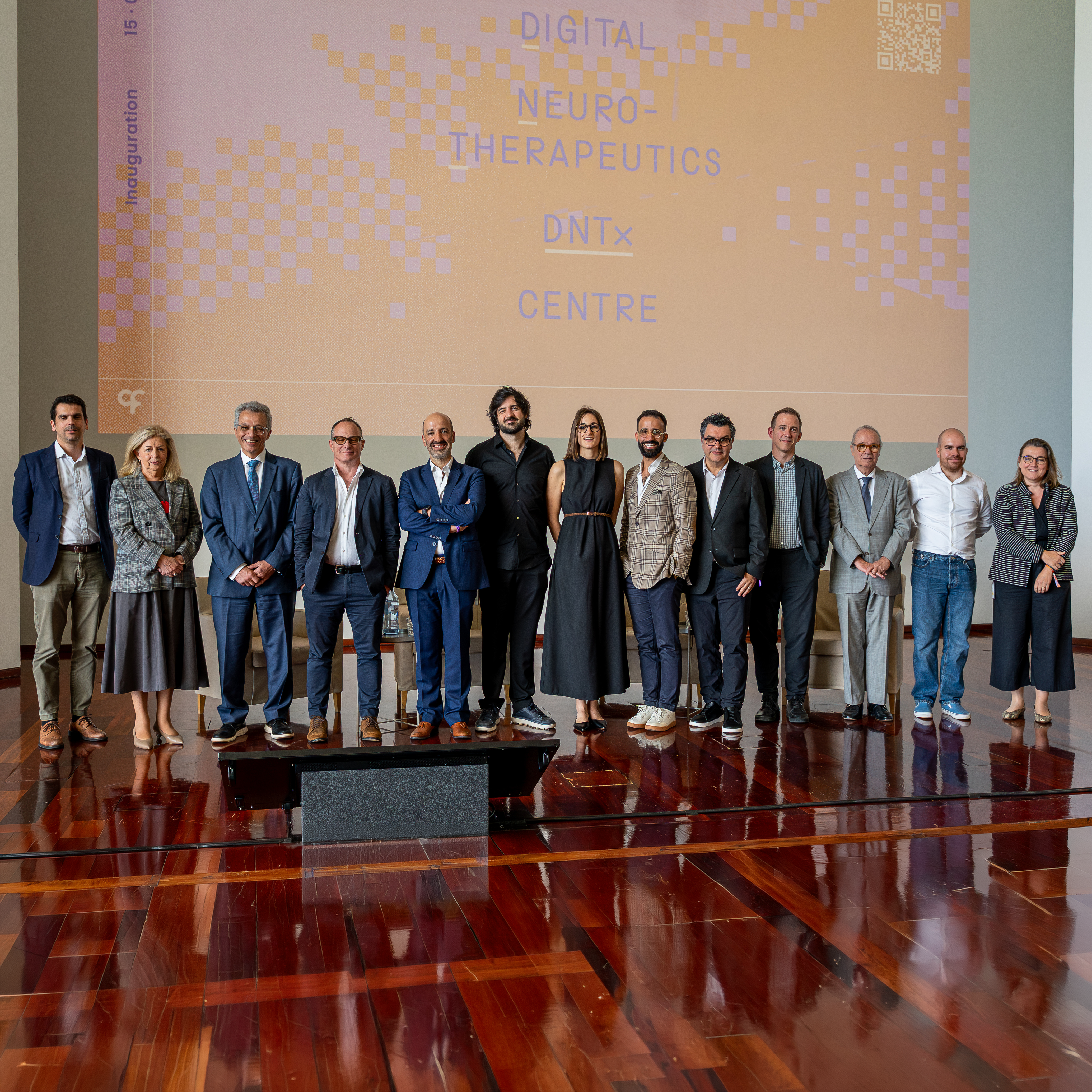
Redefining brain and mental health care through neurotechnologies – from Alzheimer’s to stroke, from Obsessive Compulsive Disorder to depression –, is the declared goal of the new Digital Neurotherapeutics Centre (DNTx), which opened its doors to the public at the Champalimaud Foundation (CF) on May 18th.
The inauguration of the DNTx Centre was hosted by the CF Board, with Rui Costa opening the event and Leonor Beleza, President of the CF, delivering the closing remarks. Both emphasised the strategic importance of the new centre in advancing and reshaping neuroscience research at the Champalimaud Foundation.
They highlighted the CF’s longstanding mission to promote and support transformative research developed from, with, and for patients, alongside its internationally recognised programme in fundamental neuroscience. Within this vision, the DNTx Centre was presented as a next step in the CF’s broader mission; consolidating neuroscience research and clinical care for patients with brain and mental disorders.
According to the WHO, brain-related disabilities are the number one threat for human society. Why is the development of new treatments based on neurotechnology necessary? John Krakauer, co-director, along with Joseph Paton, of the newly formed Champalimaud Institute for Brain Research and Repair (which encompasses the DNTx Centre, the Neurotechnology Warehouse, the Champalimaud Neuroscience Programme and the new Neuroscience of Disease Programme), explained that “neurological and psychiatric problems have not and will not be solved by pharmacology alone. Despite numerous attempts, there is no pill to aid recovery from stroke. For Alzheimer’s, the benefits of the latest anti-amyloid antibody trials have bordered on trivial. The latest anti-alpha-synuclein trial in Parkinson’s Disease was negative”.
“Psychiatry has had its own problem with pharmacological treatments stuck at a mechanistic bottleneck”, he added.
Brain stimulation
Psychiatry is, however, now paving the way with neurotechnology.
One of these neurotechnologies, which has been approved for treatment-resistant depression and for which there is a growing amount of promising data, is noninvasive transcranial magnetic stimulation (TMS).
Treatment for depression with TMS has been ongoing since 2018 under the leadership of neuro-psychiatrist Albino J. Oliveira-Maia, Director of the DNTx Centre, with more than 200 patients having been or being treated with it. It consists in applying a magnetic field to a certain site on the scalp of the patient in order to generate electrical currents that will help activate targeted brain regions that have proven to be associated with depression.
It is now also being tested for other conditions, such as Obsessive Compulsive Disorder (OCD) and mania.
The keynote talk, titled “Brain health in the Era of neurotechnology”, was delivered by Spanish-American neurologist Alvaro Pascual-Leone, from Harvard Medical School – a leading expert in TMS and use of neurotechnology to treat neurological disorders and promote healthy aging. “The current approach to brain health”, he said, “is waiting for symptoms to appear, and then for a specialist to try to treat the condition. We need to start detecting disease at its earliest, even in health, to improve resilience.”
“The most important technological innovation in medicine are mobile technologies”, he emphasised. “We now have tools to optimize the assessment of how our brain is doing.” In a sense this technology can be considered the new “chair” whereby the physician listens to the patient describe their symptoms but now also gets fine-grained longitudinal data. Neurotechnologies, combined with pharmacology, will become critical in dealing with brain impairment and promoting brain health.
Invited speaker Giacomo Koch, from the University of Ferrara (Italy), explained how TMS is an exciting new treatment for patients with Alzheimer’s Disease (AD) with promising trial results. In animal models it appears that TMS mitigates neural network dysfunction, and decreases both neuronal death and beta-amyloid deposition (beta-amyloid is a protein associated with AD that forms abnormal deposits in the brains of patients).
Gonçalo Cotovio, psychiatrist and clinical researcher at the CF, has also been working with TMS in close collaboration with Oliveira-Maia. “Innovation in medication for mental health has been lacking despite being the most incapacitating condition”, Cotovio said in his talk. “TMS is focal, safe and noninvasive. Patients do not frequently stop TMS because of side effects”, while this is more likely to happen with medication.
Immersion
The clinic will also offer a range of immersive digital therapies including proven exergaming approaches, and through recruitment into trials that use virtual reality (VR) and new full-body motion capture immersive rooms. Fatemeh Molaei, from the CF’s Neurotechnology Warehouse (the innovation “arm” of the Centre for Restorative Neurotechnology) talked about the potential application of immersion to the treatment of OCD through the creation of personalized aversive environments.
There are several hurdles to implementing such a technique – for instance, to be used for effective treatment, virtual scenarios will have to include the presence of the patient and of the therapists themselves. Moreover, the scenes will have to be sufficiently realistic to enable placing the patients in situations where their anxiety symptoms can be triggered by their OCD. As part of an ongoing OCD feasibility trial, Molaei mentioned the case of a woman who suffers from “contamination OCD”, hating her kitchen because she thinks it is always dirty, and needs to constantly clean it. Creating a realistic scenario of her kitchen and giving her an immersive sense of her own presence and that of others in this virtual context is one of the challenges the scientists hope to overcome.
Carolina Seybert, clinical psychologist at the CF’s Neuropsychiatry Unit and now also working in the new Centre, spoke of another type of immersion that will also be approached at the DNTx Centre: the use of psychedelic drugs. This is a type of immersion that uses a pharmaceutical tool that produces an altered state of consciousness. Drugs such as MDMA (ecstasy) and psilocybin (mushrooms) have been approved, respectively, for the treatment of PTSD and major depressive disorder, as well as LSD for generalised anxiety disorder. She talked in particular of the issues surrounding informed consent and the safety of the patients submitted to this treatment.
Games against disease
Finally, Silvia Salvalaggio, physiotherapist and researcher at DNTx Centre, an expert in neurological rehabilitation, talked about “exergaming” in stroke rehabilitation. Exergaming is the use of digital versions of gamified physical exercises to deliver training in a more engaging way. The first of this kind of digital therapeutic was developed in the US, at Johns Hopkins University, by Krakauer and his team. It was subsequently acquired by the company Mindmaze. The game, MindPod Dolphin, reproduces the behaviour of a dolphin that the patient can control with the movement of their arm. Through tasks (e.g. chasing fish, performing jumps) it is possible to deliver doses of training in terms of cognitive challenge, cardiovascular exercise and practice at skilled arm movements, that are not possible with conventional physical therapy - “We just have to make intense training fun”, says Krakauer. It has since been cleared by the FDA to deliver high-dose and intensive rehabilitation therapy.
Other exergames are being developed at the Neurotechnology Warehouse using generative AI and new kinds of motion capture.
Earlier, during his talk, Co-Director Marcelo Mendonça had also mentioned exergames with respect to his area of expertise, Parkinson’s Disease (PD), noting that at the DNTx Centre it will become possible, through game development, to continuously monitor and measure PD patients’ motor impairments (for instance, freezing of gait). “With the right framing and tools we can alleviate patients’ symptoms”, he said.
Patients voices
In his keynote, Alvaro Pascual-Leone had touched on the need for patient empowerment – the need to consider and integrate patients’ voices in the whole process, from research design to therapeutics development.
This was embodied by two patients – a woman living with Parkinson's Disease and a man suffering from contamination OCD – who described their personal experience and medical journey. She told the audience about her years of efforts and consultations with more than a dozen specialists to finally be correctly diagnosed. The patient with OCD said that thanks to TMS, he can now leave the refuge of his home and lead a normal life, something that he had not been able to achieve when treated only with medication and psychotherapy.
"The inauguration of the Digital Neurotherapeutics Centre represents an important step in bringing new, evidence-based tools into the treatment of brain disorders”, said Oliveira-Maia in his closing remarks. “By combining virtual reality and artificial intelligence, we can create therapeutic experiences that are tailored to each patient and that adapt over time based on their responses. These approaches are already being applied to conditions such as addiction, depression, anxiety, and neurological disorders, helping patients train their brain in a more engaging and measurable way. By connecting research directly with clinical care, we aim to make these innovations both effective and accessible to the people who need them most."
At the end of the day’s programme, participants were invited to explore parts of the new DNTx Centre facilities, with opportunities to experience firsthand, or see simulations of, some of the therapeutic solutions currently being implemented. They were also introduced to a fully-instrumented kitchen that can capture movement of the whole body, including the hands, while a patient performs an activity of daily living like cooking. In this way one can get objective quantification of real-world behavior and capture how it improves with digital neurotherapeutic interventions.
Text by Ana Gerschenfeld, Health & Science Writer of the Champalimaud Foundation. Edited by John Krakauer, co-director of the newly formed Champalimaud Institute for Brain Research and Repair.