“I can see crosswalks in the street, which I've not seen in 18 years”. José-Alain Sahel was recalling, in an interview this September at the Champalimaud Foundation, the astounding words of the first totally blind patient he treated in Paris for a degenerative disease of the retina with an absolutely novel therapy called optogenetic therapy.
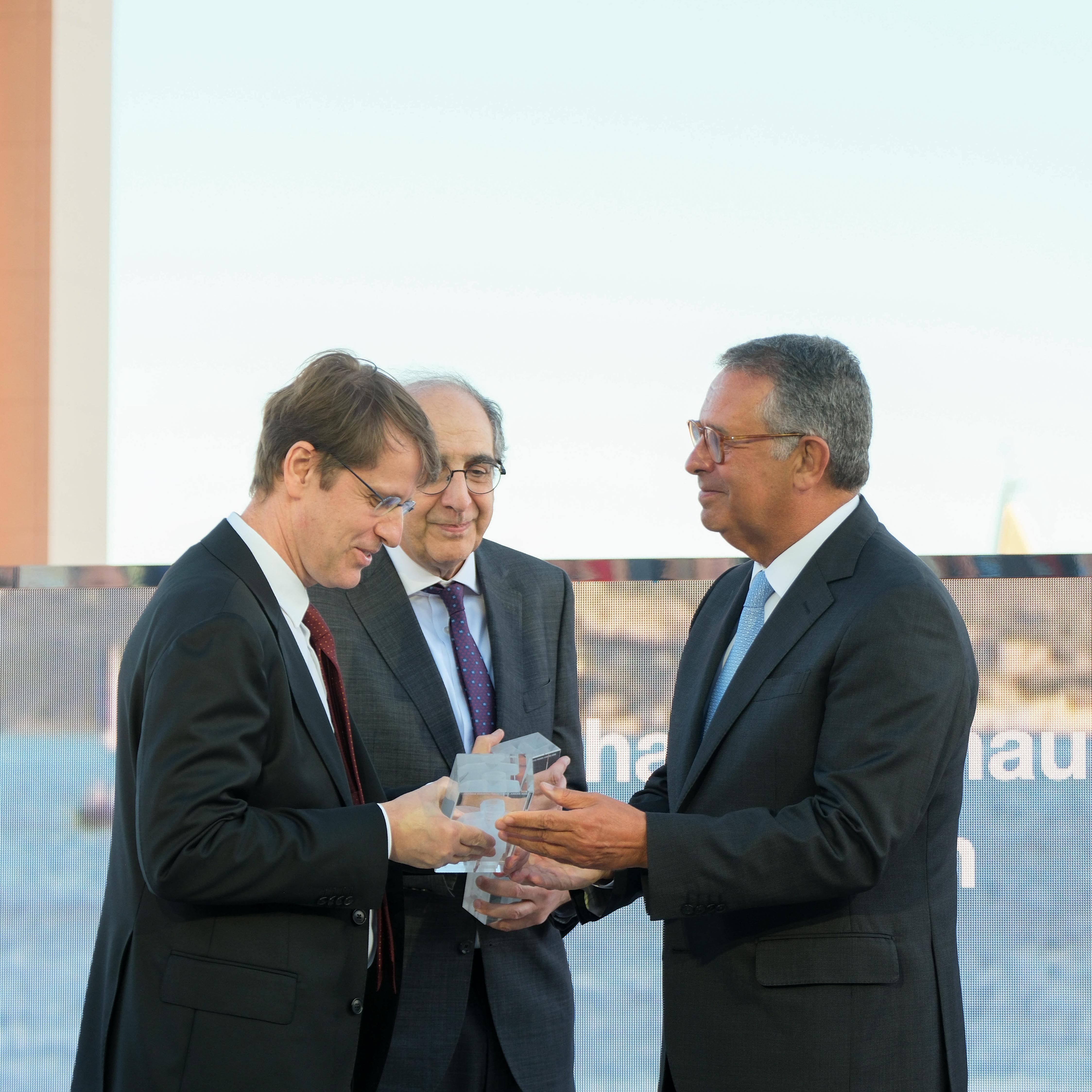
The breakthrough result was published in Nature Medicine in 2021. The technique had been developed by Sahel – an Algeria-born French ophthalmologist and researcher, from the University of Pittsburgh School of Medicine and founding director of The Institut de la Vision in Paris – in collaboration with his long-time friend and colleague Botond Roska, a Hungarian-Swiss medical doctor and biomedical researcher, founding director of the Institute of Molecular and Clinical Ophthalmology in Basel. Now they have jointly received the one-million-euro António Champalimaud Vision Award for their pioneering work.
The patient was 58 years-old and had been completely blind since the age of 40. He suffered from retinitis pigmentosa, an inherited form of retinal degeneration that progressively kills cones and rods, the light-sensitive retinal cells at the back of the eyes that allow us to see.
Optogenetics is a genetic engineering method that has been used for the last 20 years or so, in the lab, to study the brain in animals, from fruit flies to mice. It consists in selectively introducing into neurons a gene from algae, expressing a light-sensitive protein, so that they are rendered sensitive to light. Then, by shining a light on the neurons expressing the gene, it becomes possible to activate or inactivate them at will, depending on how, where and when these genes are expressed, which allows neuroscientists to control them and study their function.
Roska and Sahel have been working together for about two decades on developing “optogenetic therapy”, which they saw as a promising way to restore retinal function in blind patients. “I had been working on it since 2005: optogenetics was one of the obvious things to do”, said Roska, in a separate interview. “But when I went to conferences and told people that I would like to apply optogenetics to patients, they told me I had lost my mind. Putting an algae protein into humans!?”
“The only person who took it very seriously was José [Sahel], who told me ‘let’s work together and bring this to people’”, he adds. “People were laughing at this, saying it was ridiculous”, agrees Sahel. “I was pretty depressed about it.”
Indeed, optogenetic therapy involves the insertion, into retinal cells (cone cells, bipolar cells or ganglion cells), of a gene from algae that has the capacity to turn those cells, which are not naturally light-sensing (or had lost their ability to do so), into photosensitive cells that mimic the photoreceptors in the retina that have been lost to disease. Those cells should thus become able to transform light stimuli into electrical signals, that would then be sent to the brain for visual processing.
The technological hurdles were huge. Roska and Sahel had to start from scratch, the ultimate goal being to translate the technology from the lab to the clinic. “I would say the [initial] laboratory research was done in my lab, but we have been doing all the translational work together”, Roska noted.
They first worked with mice, then human retinal organoids (structures grown in a dish from human cells, which resemble retinas), and finally in human retinas kept alive post-mortem. Once the likely safety of the intervention for patients was established by its application to non-human primates, they injected the gene into the eyes of totally blind people.
The work was technology-intensive. Among other things, the researchers had to deliver the algae gene to the right cells in the retina so they would express it and become light-sensitive; they had to engineer the right vector (from an innocuous virus) to deliver and express the gene in those cells. This took years. “It's purely technology and improvement of technology”, says Roska. “We didn’t bet on luck; we bet on hard work!”, adds Sahel.
Optogenetic therapy entails an injection into the eye. With the first patient, it took months for him to recover some degree of vision. He and the other patients in the trial, the results of which are due to be published this October, “are able to find objects, to point to them, and half of them can grab them and count them”, Sahel explains. “Some can also find a door and follow a line.”
The patients need to wear special goggles to be able to see, because their eyes are unable to adapt to ambient light. The particular algae protein used in optogenetic therapy senses amber light, so the goggles have to be equipped with a camera that captures and projects visual images onto the retina at amber light wavelengths.
What is the future of optogenetics? “I think that what really comes now is optimisation”, says Roska, adding that smart glasses will one day be developed to replace the current goggle version. Visual resolution should also improve, allowing patients to recognise faces and even read. “We are only at the beginning of a long road and probably, in the next 50 years, a lot of innovation will come from technology, from biotechnology, from goggles, from all sorts of directions, to very sequentially improve the technique”, he stresses. “We are at the clinical trial stage. And what I hope is that at one point the technology will be refined to the point where it becomes easy to use.”
Optogenetic therapy might also be applied to other retinal degenerative diseases, namely non-inherited ones such as age-related macular degeneration, the most common cause of blindness in Europe and North America.
Sahel has also, throughout his career, followed other avenues of research for vision improvement, developing prosthetic retinas and therapies to preserve and restore function of surviving cone photoreceptors (the cells that allow high resolution colour vision). “There is much more work to be done”, he points out.
Before starting to collaborate with Sahel, Roska’s research had uncovered novel complexities in the neural networks that structure visual processing, and he had pioneered viral techniques to chart retinal circuits. Using genetic engineering to introduce light-sensitive proteins into surviving cones and other retinal cells, he had successfully elicited, in photoreceptor-deficient animals, electrical responses in the retinal cells that send visual information to the brain. These scientific discoveries opened innovative pathways toward therapeutic vision restoration in humans suffering from retinal degenerations.
“We're looking at human diseases, trying to understand their molecular and physiological basis and turning them into therapies”, Roska says. “Many of these therapies will probably fail. But somebody has to start doing it.”
“Some of my research had not been planned”, says Sahel. It just happened that I met a patient who needed it. Everything I do is driven by patients. My main motivation for research is to be able to tell patients that we don't give up, that we continue our work! The Champalimaud vision award is the type of recognition that gives you the energy to continue.”
Text by Ana Gerschenfeld, Champalimaud Foundation’s Health&Science Writer