There is a line by British artist David Shrigley that goes: “I had no interest in it then I looked inside and now I'm enchanted by it.” In other words, it is difficult to be genuinely interested in something we know nothing about. First, we need the chance to take a look inside. To get closer. To explore. To ask questions. And sometimes, it is at that very moment, when something that once seemed distant becomes tangible, that fascination begins.
The same is true of science.
But what if, instead of looking inside a laboratory, we could taste what happens there? That was the invitation behind the second edition of Science Kitchen, which brought together five researchers and five chefs at the Champalimaud Foundation to transform scientific research into a gastronomic experience.
Over several months, the five pairs crossed the boundaries between their worlds: chefs stepped into laboratories and researchers into kitchens. They observed each other’s methods, exchanged questions and experimented with different languages. In the end, their meeting point was a tasting menu built around questions that research is still seeking to understand.
What if a scientific question could be served on a plate?
How can we make visible what distinguishes one tumour cell from another? What happens in the brain when we experience fear? How are our food preferences formed, and what roles do pleasure and memory play? How do we sense protein and decide what to eat? And how might the choices we make throughout our lives influence our risk of developing cancer?
The answers were not on the menu. The questions were.
Chef Diogo Formiga and researcher Carlos Ribeiro began with the question, “How does an animal sense the taste of protein and decide what to eat?” Their answer took the form of a starter made with mushrooms and yeast broth, opening up a wider reflection on sustainable plant-based protein.
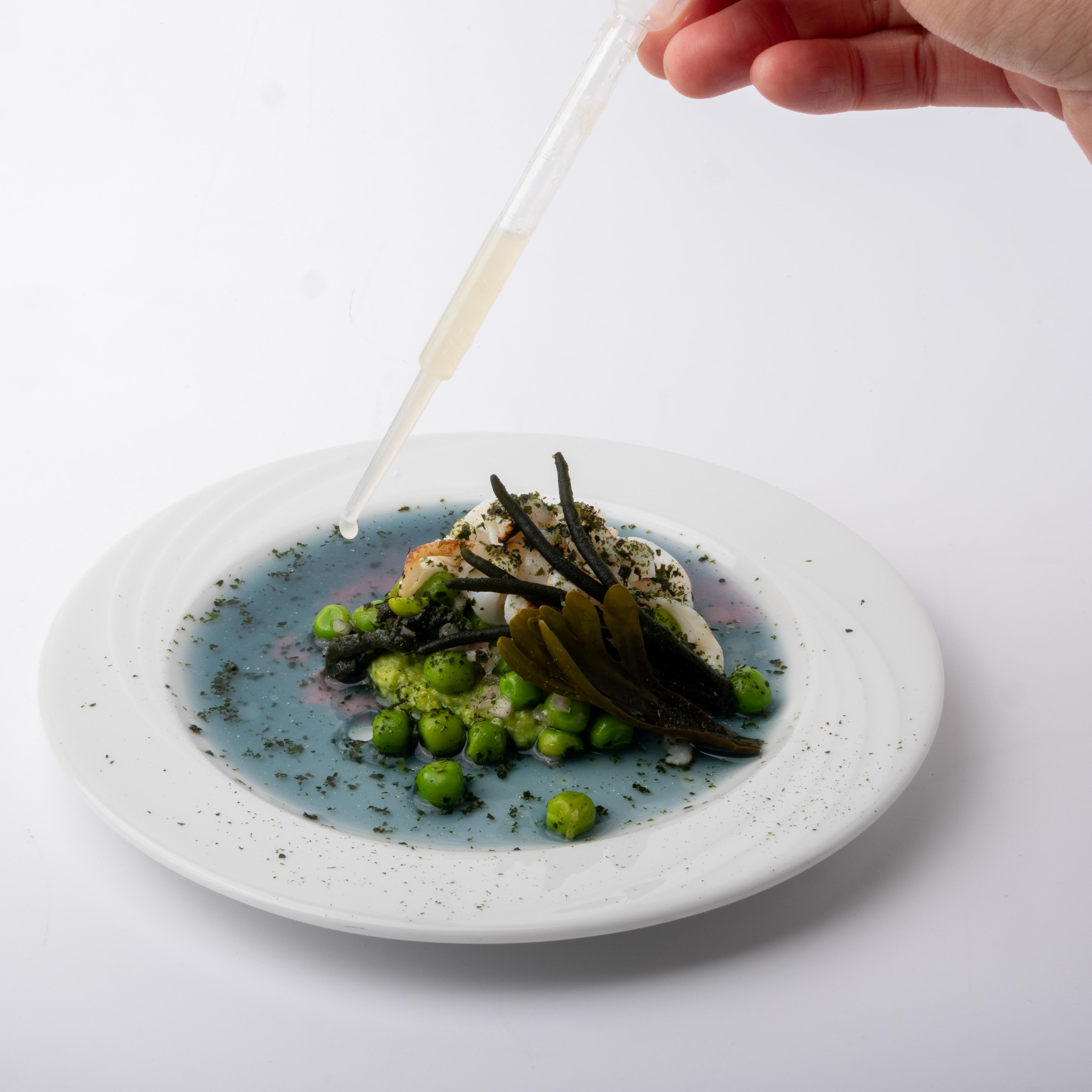
Chef Joana Duarte and researcher Rita Fior transformed cancer diagnosis into a dish of squid, peas and seaweed inspired by biomarker labelling techniques.
Stress and survival were the territory explored by chef Alexandre Silva and researcher Marta Moita, who created a fish dish inspired by research into how animals’ brains respond to fear.
Turning to mental health, chef Luís Gaspar and psychiatrist and researcher Joaquim Alves da Silva explored the “Memory of Taste”, looking at the relationship between pleasure, body, brain and memory in shaping our food preferences.
And for breast cancer prevention, chefs Lara Figueiredo and Daniela Ferreira, together with medical oncologist and researcher Andrea De Censi, created an anti-inflammatory, sugar-free dessert.
Five dishes. But above all, five ways of making a scientific question less abstract.
At first glance, a kitchen and a laboratory may seem to belong to entirely different worlds. But, as David Shrigley wrote, all it takes is a closer look. There are workbenches, tools and raw materials. There are protocols, precision and technique. There are hypotheses that work, and others that send you back to the beginning. There is observation, trial, error and repetition. And in both places, there is an extraordinary curiosity about what is not yet known.
“This encounter proves that the kitchen and the laboratory share several ways of thinking,” explains Carlos Ribeiro, researcher at the Champalimaud Foundation and coordinator of Science Kitchen. Beyond the more visible similarities, “from chefs’ jackets and lab coats to workbenches”, the two worlds share a spirit of investigation: an effort to understand how each individual element contributes to an outcome that gradually takes shape through experimentation.
For Paulo Amado, founder of Edições do Gosto and also a coordinator of Science Kitchen, this coming together is also an opportunity to think differently about the relationship between food and health. Chefs and scientists, he says, ultimately face similar challenges: “to understand, to predict, to make things happen”. Both work in the face of the unknown, and both experiment in order to move forward.
Science Kitchen was born in 2025 from a conversation between Carlos Ribeiro and Paulo Amado. A year later, it returned to the Champalimaud Foundation for its second edition, continuing to explore what can happen when science and gastronomy move beyond simply existing side by side and genuinely step into each other’s worlds.
Because bringing people closer to science may not simply be about finding easier ways to explain what we already know. It may also mean giving them access to what we do not yet know. To the questions. To experimentation. To the curiosity that sets research in motion. Sometimes, the way in is through a laboratory door. Sometimes, it is through a plate.
Text by Catarina Ramos, Co-Coordinator of the Champalimaud Foundation's Communication, Events & Outreach Team
Photo by Alexandre Azinheira, Champalimaud Foundation's Multimedia Plataform